
A few weeks ago I was asked to give one of two keynotes at our faculty research day with the general prompt as ‘provocation around AI and HE’. It was a perfect guide for me.
So weeks before I wrote the talk, I knew that I wanted to create a clone of myself that people could interact with and speak to. This idea of the robot being realistic and how it makes us feel is not a new discussion. Japanese roboticist Masahiro Mori laid out the idea of the uncanny valley way back in 1970. The image Mori created is available online so I won’t test copyright to share it here, but the premise is that there is a baseline of neutral human likeness/affinity and the Y axis is our affinity towards something and the X axis is how human like it is. Mori also maps 2 things: moving and still robots, which do move across the graph in slightly different ways with the moving robots fluctuating more than still ones. The graph maps that as our ability to create more human like robots grows, our affinity grows with them - to a point.
As affinity and likeness starts to grow we get the cute little cuddly robots, big eyes, adorable. And we love them.
But then there comes a point when it’s almost too real and is weird, or odd, or unsettling, and this is where the uncanny valley comes in. Both moving and still robots here dip below the neutral line and we (living people) actually are a bit creeped out by them. This could look like the robot Sophia, who has very human-like qualities, she even has an Instagram, but can still unsettle.
The upside of the uncanny valley is where things become even more real and we start to accept them more. This is where we might see clones. And this is where I want to start my consideration of the uncanny valley.
First of all, I want to draw attention to something that was also brought to my attention on the day I gave this talk: that phrasing such as the ‘uncanny valley’ and a variety of the terms used in AI and computing and the area I’m writing about today has connotations of ‘fixing/correcting/normalising’ things; there are also similarities in the languages used when discussing those with autistic traits. It’s something to be aware of when considering the uncanny valley, and should stay in our minds as we move through it.
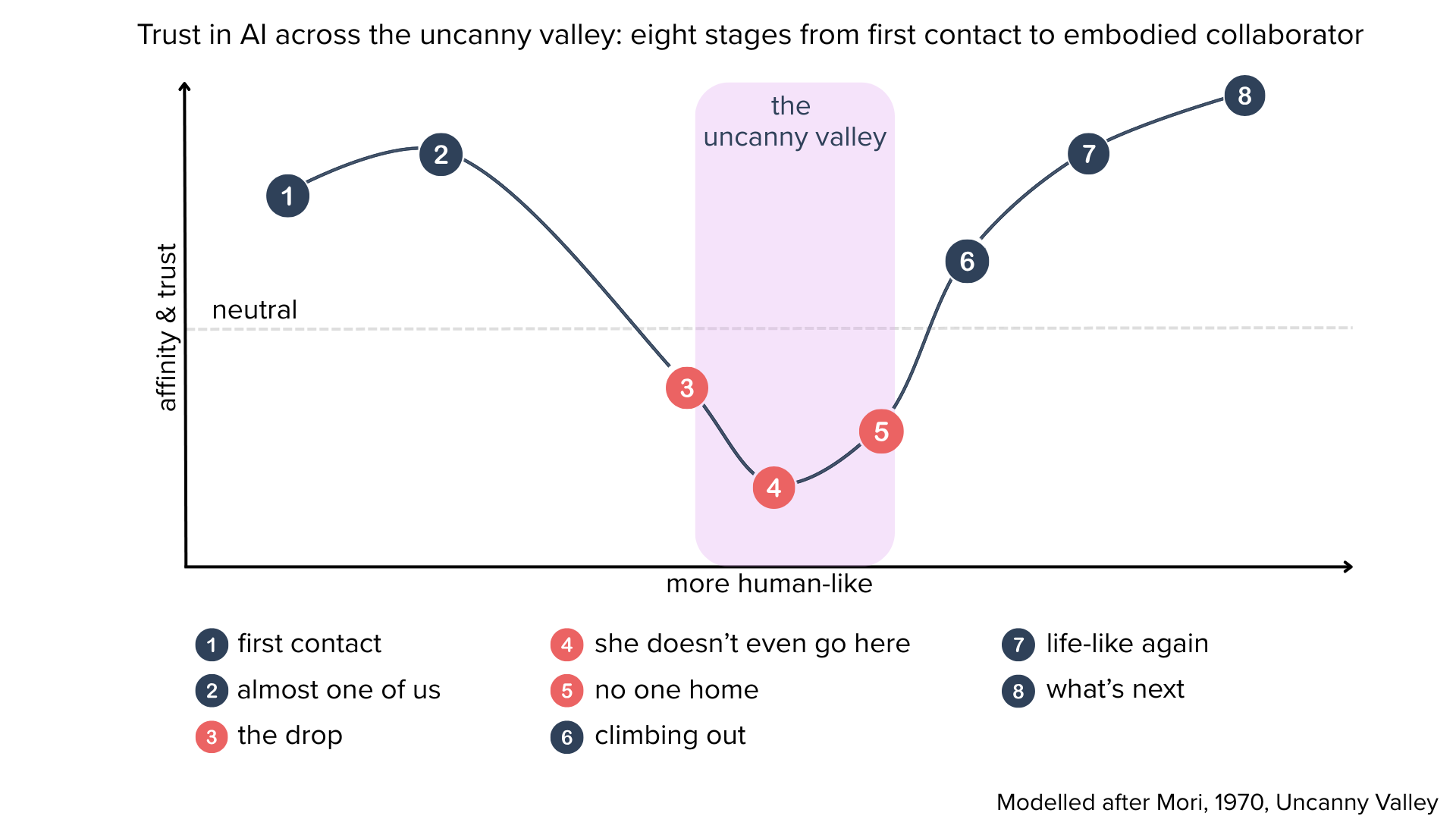
Building on an array of scholars writing about AI, LLMs, chatbots, robotics, the uncanny valley, I wanted to briefly map out how I think it relates specifically to HE and research more widely. The image below shows the journey, and it needs a Mean Girls reference because it fits, and I’m of an age where this sort of inclusion amuses me.
First Contact
The idea of First Contact; the first point on the journey is about why we warm to the machine at all. It’s the early rising slope. And, affinity climbs with human-likeness. Familiarity and trust become really important under uncertainty (Gefen, 2000; Pavlidou, 2021). We see the ideas of familiarity and trust coming in across different technologies. Like McLuhan’s rear-view mirror, where we view new technology through the old - think of skeuomorphic design: page turn on an eReader, why digital pianos look like piano keys, etc.
We can start to think of AI as a benign research instrument here, where trust may be higher because human-likeness is low. It may be things like search, transcription, reference tidying, the whole spellchecker lineage; no one panics about a tool that doesn’t pretend to think.
Almost one of us
“As users engage in conversations with LLMs, there is an approximation of human-like interaction and responses” (Kirkeby-Hinrup and Stenseke, 2025).
How many of us have said please or thank you to an AI? I have. The joke is that it’s better to be kind and friendly to our future overlords.
“Chatbot agents, which feature a disembodied text-based conversational interface, represent the lowest level of anthropomorphic form” (Schlesener, et al., 2026). AI feels as if it moves up the cognitive ladder into summarising the literature, drafting, coding, writing the analysis. It is still augmentation, still legibly owned by you. Affinity peaks right before the work stops feeling like a tool. And, we see news articles about this all the time, people falling in love with their AI, doing what it says, AI psychosis, etc.
The Drop
The uncanny feeling kicks in here. That vibe can include several kinds of emotions, such as fear, disgust, nervousness, dislike, and shock (Zhang, et al., 2020). Pavlidou found this to be the case in their MA thesis where a “hyperrealistic avatar induced a greater feeling of eeriness and subsequently reduced the trust in the chatbot” (2021) – and people were less willing to reuse the chatbot.
The thing that matters is that this is content that reads as almost human, the gloss of it being nearly right, clean, sterile, somewhat Stepford wife. Plastic. Which is a nice link with what Roe, et al. (2025) work on the concept of digital plastic.
Digital plastic is what Roe and colleagues call synthetic media. These are things like generative AI: “Digital plastic is, like its physical counterpart, synthetic, ubiquitous, helpful and potentially toxic.” (Roe, et al., 2025). These are the things that we see online that people fall into, the ‘me as a doll/action figure’, ‘me in the 80s’, or even that glossy sheen of AI generated content in both written work and visual design (think of how quickly AI image content grew in local marketing and restaurant signs).
This is the point where AI can produce scholarly prose that passes as ours. The first real unease is not technical, it is about whose words and whose argument this is. Integrity flags go up and the descent begins into the valley.
She Doesn’t Even Go Here
“When humans interact with social robots, our norm and value perception systems are activated” (Laakasuo, 2023). We also have no equivalent intuition for judging a contribution made by a system running on probability and symbolic logic (Laakasuo, 2023).
The objection that we come up against with AI is rarely that the output is bad (though sometimes, it is), it's that the thing producing it doesn't belong, hasn't earned its place, hasn't gone through what the rest of us went through. And this isn’t quite in the same way that groups talk about ‘kids these days with their iced coffees in interviews, avocado toast, while I walked miles barefoot to school’ type of thing. It’s quieter and is linked to what Laakasuo argues in that we simply cannot evaluate contributions made by probability and symbolic logic the way we evaluate other humans. When we make a humane-related judgement, our social cognition fires deeply and automatically (Voiklis and Malle, 2017). With AI, that machinery has nothing to grip onto like trying to grip a slick, shiny piece of plastic.
So the field does what fields do when the boundary is threatened. Some journals/publishers refuse to list AI as an author (to be fair, there is a worry of backlash from readers too here). Integrity panels draw lines about how AI can or cannot be used within their remit. Learned societies issue statements about how it can/cannot be used and what it means in their field. Read that through Bourdieu and it's a struggle over who holds position, because authorship isn't just a label, it's the currency that converts into jobs, citations, grants, and standing. And the idea is uncomfortable, even now, to think that someone who used AI to do their work, got a job/grant/publication over you - who didn’t. I too fall prey to this, sometimes applying for jobs I am qualified for, or overqualified for (academia is…not flush with roles), and do not get anywhere and think: why did I waste my time writing the statement/cover letter/CV myself when I could have outsourced to an AI with the same, or better results?
What’s interesting is that the publishing industry performs this contradiction openly in places: condemning AI authorship while quietly running AI through its own production pipeline; this is changing a bit though as we see more nuanced stances on the use of AI coming through, often being led by the academic publishing world.
No One Home
Theory of mind is our ability to track other people's mental states. It's central to every human social interaction, from conversation to empathy to moral judgment. With chatbots and GenAI, there is a reduced Theory of Mind and nothing socially at stake, so it registers as unease. A hollowness, nothing behind the eyes.
“AI systems inherently lack the capacity for emotional states and cannot be held accountable for their actions in the same way as humans” (Schlesener, et al., 2026). We pick up on the lack of emotional states, and AI tools in turn are picking up on this, and are becoming more and more ‘human’ in how they feel.
Kirkeby-Hinrup and Stenseke make an important distinction here. In normal human interaction, reduced theory of mind capacity produces anxiety and stress. But with LLMs, because nothing is socially at stake, that same absence registers differently. It doesn't alarm us. It just unsettles us.
And it matters for research specifically because AI produces answers, citations, findings, all the surface features of accountable scholarship, with no mind behind them. No one who reasoned their way there. No one to question, challenge, or hold responsible.
It’s beautifully written, but perhaps the citations are a bit off, or it plays fast and loose with paraphrasing, or it talks in well-written generalities, or it uses writing that might work in a speech, but looks oddly formulaic on the page.
Climbing Out
Climbing out is about the system. This is where transparency, audit trails, and process design restore trust. The AI has not necessarily changed, but the infrastructure around it has and we see this when the systems surface and reference real sources, RAG models = prompt + outside info + LLM knowledge/NLP, etc.
Climbing out is about the system developing trust in the guardrails, the institutional response and accepted use cases - and this shows up as:
- citations,
- the infrastructure around AI,
- humans-in-the-loop
- tools showing their working.
The trust is not necessarily in the AI itself, it is in the guardrails that the evidence we can see saying, in effect, YOU CAN TRUST THIS! IT CITES ITS SOURCES.
We also see more embodiment, the AI feels more human, we can tweak its tone of voice, and how it replies, and this also helps the return of trust. Anthropomorphic form and embodied conversational agents, are part of this, and research is finding that embodiment lifts trust (Schlesener et al., 2026).
Lifelike Again

So the short version: ‘Climbing Out’ is trusting the process, ‘Lifelike Again’ is trusting the partner. One is all about the governance of these tools, the other is related to the experience we have of using them, thinking about AI as a collaborator under supervision, which can bring back our feelings of affinity.
“Recent findings suggest that highly anthropomorphic robots equipped with LLM-enhanced conversational capabilities can reduce feelings of eeriness and improve user perceptions of human-likeness, conversational naturalness, interestingness, and overall acceptance” (Kang et al., 2025, cited in Schlesener et al., 2026). So we like it now when we can recognise the face or tone of our gen AI tools.
When these tools are becoming lifelike again, it links to the relationships we have with them. For instance, I have friends who have named their AI tool of choice. I don’t mean ‘Chat’ or ‘Claude’, I mean ‘Frank’, ‘Chad’, etc. This is where the research on embodied agents and anthropomorphic form comes back in: Schlesener et al. (2026) found that users rated an embodied conversational agent as more trustworthy than a chatbot with a synthesised voice.
The highly realistic LLM-enhanced agents are reducing that feeling of eeriness. The affinity we have for the tools returns because the interaction starts to feel like a genuine collaboration with accountability, a back-and-forth with something that responds to you in ways your social cognition can process.
I would highly recommend reading the work by Schlesener and colleagues linked in this piece for much more detail on the links (or not) between embodied agents, chatbots and Theory of Mind.
So what’s next?
Now we’ve fully gone through the uncanny valley on this journey and are out the other side. So what’s next? What happens when AI becomes more real than the real? This is where we move into hyperreality and transhumanism, which is not my speciality at all, but it’s an interesting movement.
This is already happening in HE:
- “EdTech organisations such as Prifina, Khanmigo and Cogniti are now developing new AI teaching clones”. (2024)
- Meet David Joyner, the professor who cloned himself with an AI avatar named ‘DAI-vid,’ as part of an experiment to ‘democratize’ online learning (2025)
- Professors blindsided by new ASU AI tool that chops up their lectures and uses them out of context (2026)
- When the Teaching Assistant Is an AI ‘Twin’ of the Professor (2024)
And now we have this idea from Cogniti devs that Cogniti is the AI ‘stunt double for educators’.
I’m personally of two minds: I like the idea that my work is important enough that I need a stunt double, but I’m also realistic enough to know that like in all good corporations, I’m entirely replaceable. I’m just now unsure if this replacement is via the machine.
MJAI
In order to see how easy it was to pull together different existing tools to create my own digital twin, I threw together a digital office space for my Avatar, MJAI. Here you can go into my ‘office’, read info on the modules I’m teaching, have links out to the university Moodle pages, get the documentation, etc. But the key here is being able to ask me a question about the modules I teach, and have me answer it. Using APIs linking up a pipeline of Claude, HeyGen, and Chrome’s speech to text feature, I built a pipeline that retrieves answers from 12 lectures from one of my modules (as pdf lecture slides), with each response limited to two sentences for time’s sake. You can ask me a question such as: what is an RRP? What should be in a Marketing Plan, etc. And within a minute, I would pop up in video format and answer the question.
This is not on the web to give a go. I built it locally for the purpose of this talk with a live demo, but below is a short video of the tool at work showing how easy it is to replicate our likeness and, you know, tug on a small worry that we as academics in a challenging HE situation, may be replaceable by…us.
To end
I never thought I’d be quoting the Pope, but here we are. Moving fast and breaking things makes one do unusual coping activities. Earlier in 2026 the Pope said: “Technology is never neutral” (Pope Leo XIV, 2026).
And that is something I completely agree with.
He goes on to say that “Technology has the power to heal, connect, educate, and protect our common home; but it can also divide, exclude, and generate new forms of injustice. In the abstract, technology in and of itself is not a solution to humanity’s problems, just as it is not inherently evil. In practice, however, technology is never neutral, it takes on the characteristics of those who devise, finance, regulate and use it”.
And frankly, that’s the bit that’s concerning.